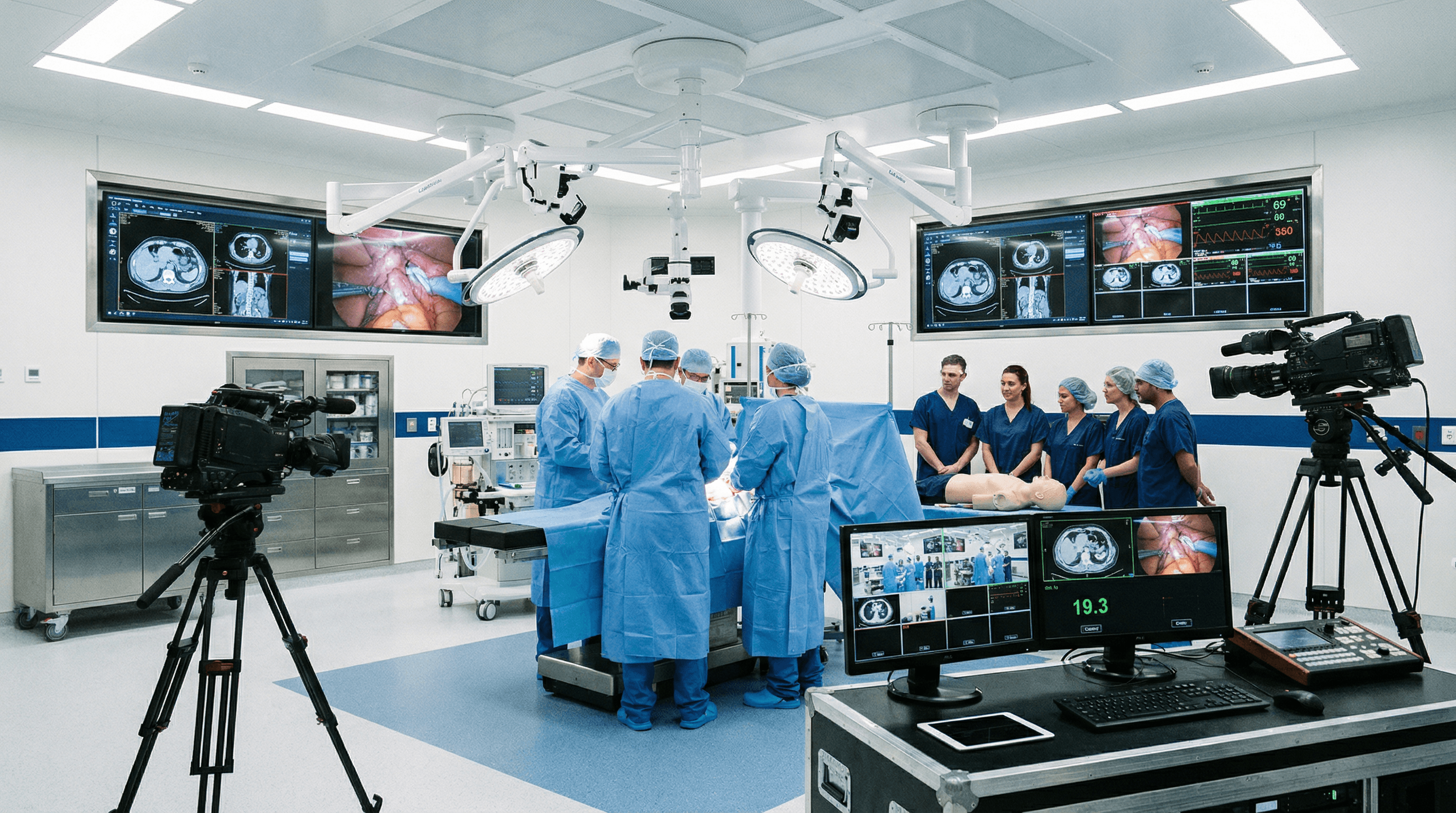
Healthcare applications demand reliable video capture for surgical documentation, telemedicine consultations, and training. Consumer dongles aren't designed for clinical environments-they're built for the occasional Zoom call, not for all-day capture or mission-critical feeds. Professional USB capture devices offer the stability and image quality that medical staff and compliance require, without the driver headaches that IT departments dread.
Use Cases in Healthcare
Medical video capture spans several distinct needs. Surgical recording requires stable, low-latency capture from endoscopy or room cameras for archives and teaching. Dropouts or freezes mid-procedure are not acceptable; the capture path has to be as reliable as the rest of the theatre stack. Telemedicine often involves capturing a secondary source-a dermatology camera, ultrasound, or scope-alongside the main consultation feed, so the remote clinician sees exactly what the in-room team sees. Training and CPD content benefit from clear, consistent capture that can be edited and shared without quality loss. In all cases, devices that work consistently without driver issues reduce support burden and downtime, which in a clinical setting is more than a convenience.
- Surgical recording – Capture from scope and room cameras for documentation and teaching. One device per source keeps signals clean and redundant.
- Telemedicine – Integrate secondary imaging (e.g. dermatology, ultrasound) into consultation workflows. Standard UVC means compatibility with most telemedicine and recording platforms.
- Training – Produce training and CPD content with professional-quality capture. Reliable enough for long sessions and repeat recordings.
Compliance and Reliability
Healthcare IT and clinical teams should always confirm that their chosen capture hardware and recording workflow meet local and institutional policies. Professional devices from established manufacturers like Magewell are widely used in clinical and broadcast environments and can be part of a compliant workflow when used with appropriate software and procedures. The hardware itself is a known quantity-no obscure drivers, no "only works on this build of Windows"-which simplifies validation and support.
Image quality matters for clinical use: colour accuracy and resolution need to be sufficient for the intended purpose. Magewell's FPGA-based processing preserves signal integrity without the compression artefacts that can appear in consumer-grade capture. For teaching and documentation, that clarity makes a real difference.
Integration with Existing Systems
Most surgical and telemedicine recording systems accept standard video inputs. USB capture devices appear as cameras, so integration is typically straightforward: add the device, select it in your recording or streaming software, and configure resolution and frame rate to match your workflow. No custom SDKs or proprietary protocols-just standard UVC that works with the software you already use or are evaluating.
Next Steps
See our Medical & Healthcare application page for more detail. For product selection and delivery across the UK and EU, contact StreamKit. We can advise on device choice and compatibility with your existing systems-and we're used to working with healthcare and education procurement.