Magewell and Blackmagic Design are the two names that come up whenever someone outgrows consumer capture cards and starts looking at professional hardware. They are different companies with genuinely different philosophies, and the right choice depends on what you are actually doing. This is an honest breakdown, not a marketing exercise.
The fundamental difference
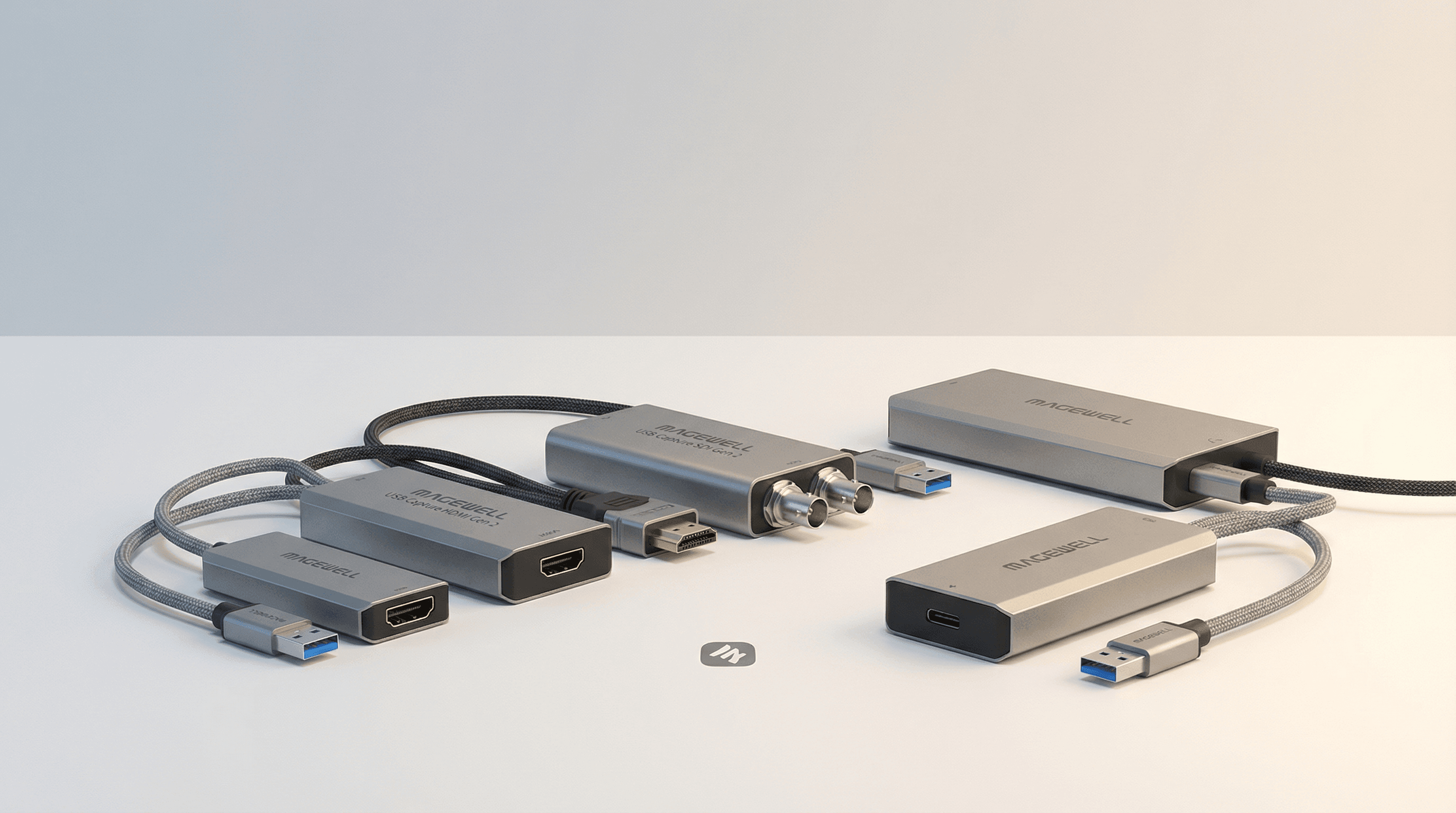
Magewell builds capture devices. That is what they do. Every product in the range — from the compact USB Capture HDMI Gen 2 to the Pro Capture Quad SDI PCIe card — is engineered specifically to get video reliably from a source into a computer. The FPGA-based processing means the device does the work: scaling, deinterlacing, colour conversion, frame rate conversion, all onboard. Your CPU receives a clean stream and does nothing else.
Blackmagic Design builds an ecosystem. They make cameras, switchers, colour grading software (DaVinci Resolve), broadcast monitors, and capture devices. The UltraStudio and DeckLink capture lines are good hardware, but they are designed to work within the Blackmagic ecosystem. The Desktop Video driver package that you must install to use them integrates tightly with Resolve and ATEM products. If you are already in that ecosystem, that integration is a genuine advantage. If you are not, it is overhead you do not need.
Drivers: the biggest practical difference
Magewell USB capture devices are fully driver-free. They use the standard UVC and UAC protocols built into every operating system. Plug them in on Windows, macOS, or Linux and they appear as a webcam. No software installation. No version compatibility to manage when Windows updates. No conflicts with other devices. IT departments love this because there is nothing to maintain.
Blackmagic requires the Desktop Video driver package. This is free and generally reliable, but it adds a dependency. When macOS releases a major update, there is usually a period where you need to wait for Blackmagic to update the driver before it works correctly. If you are running a live production environment and the OS wants to update the night before an event, you need to be careful. This is a manageable inconvenience, but it is a real one.
For PCIe capture — the Magewell Pro Capture range versus Blackmagic's DeckLink line — both require drivers. At this level the difference matters less, though Magewell's driver history on Windows Server and Linux has been more consistent for users running headless ingest servers.
Software compatibility
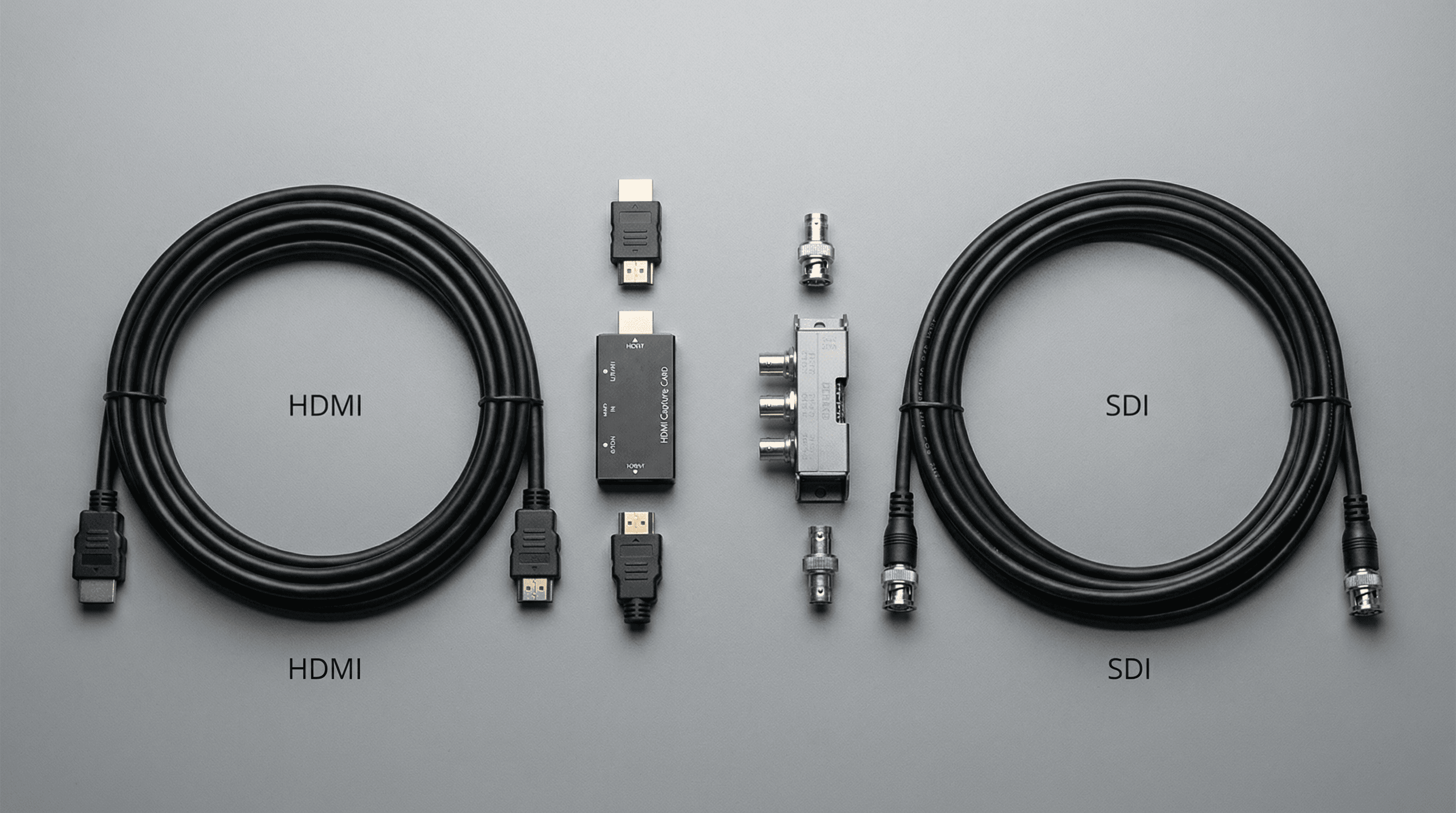
Because Magewell USB devices present as standard UVC cameras, they work with any software that accepts a webcam input. OBS, vMix, Wirecast, Zoom, Teams, Streamlabs, Adobe Premiere, QuickTime — if it has a camera selector, it sees the Magewell. You do not need to check a compatibility list. This matters when workflows evolve: a device bought for OBS today will still work if you switch to vMix next year.
Blackmagic devices work across the same applications but often require the application to have explicit Blackmagic/DeckLink support, or you use a virtual camera shim to expose the feed as a webcam. In applications like DaVinci Resolve and the ATEM Software Control suite, the integration is native and feature-rich — you get hardware-level control that UVC cannot offer. Outside the Blackmagic ecosystem, that advantage disappears.
Latency and capture quality
Both brands produce excellent capture quality at their respective price points. At 1080p60, a Magewell HDMI Gen 2 and a Blackmagic UltraStudio Monitor 3G produce near-identical output. The difference at 4K is similarly small in practice, though Magewell's newer FPGA generation in the 4K Pro does handle 4:2:0 colour subsampling that some Blackmagic USB models do not.
Latency on USB devices is around 80ms on both platforms — a characteristic of USB rather than either company's implementation. Magewell's PCIe cards offer an ultra-low latency mode (64 video lines) which is meaningful for live switching and monitoring. Blackmagic DeckLink cards are similarly low latency in their native mode. For live event production where camera-to-screen delay matters, either PCIe option is appropriate; neither USB platform is suitable for confidence monitoring where you need sub-frame latency.
Price
At entry level, the comparison is roughly equivalent: the Magewell USB Capture HDMI Gen 2 at £231.05 ex VAT versus the Blackmagic UltraStudio Monitor 3G at a similar price point. The Magewell is driver-free; the Blackmagic requires Desktop Video. Both capture 1080p60 cleanly.
At 4K, Magewell's USB Capture HDMI 4K Plus at £385.65 ex VAT sits below the Blackmagic UltraStudio 4K Mini, which carries a meaningful premium and requires the driver install. The Magewell captures 4K60 via USB 3.0 without drivers; the Blackmagic captures over Thunderbolt, which is faster but limits which computers it connects to.
If you are comparing DeckLink PCIe cards against Magewell's Pro Capture range, prices are broadly competitive at each channel count. The Magewell Pro Capture Dual HDMI at £350 ex VAT and Blackmagic DeckLink Duo 2 are direct competitors. Magewell tends to be more competitive at the higher channel counts.
Which should you buy?
Choose Magewell if: you need driver-free operation for IT-managed deployments, you work across multiple applications and operating systems, you do not use DaVinci Resolve or ATEM as your primary production tools, or you want the simplest possible setup and long-term maintenance story. This covers most streamers, corporate AV teams, education, medical, and houses of worship.
Choose Blackmagic if: you are already using DaVinci Resolve for colour grading or post-production, you have an ATEM switcher in your workflow and want native integration, or you specifically need Thunderbolt bandwidth for 4K capture on a Mac that lacks USB 3.0 bandwidth headroom.
StreamKit stocks the full Magewell range and can advise on the right device for your specific workflow. See the complete USB capture guide for a side-by-side comparison of all Magewell models, or contact us with your use case and we will point you at the right option.